King Billy Casino Payment Methods in Australia: AUD Deposits and Banking
 Available in AU
King Billy’s current terms list AUD as an accepted currency and set the minimum AUD deposit at A$30. The same terms list Visa and Mastercard cards, e-wallets and bank transfers as deposit categories, and they list BTC, ETH, LTC and USDT among accepted cryptocurrencies. That does not mean every method will appear for every Australian account or that every Australian bank or card issuer will approve a gambling transaction. King Billy’s terms specifically note that an issuing bank can block or reject card or bank transfers even when a country is technically supported. PayID and mobile wallets are common in Australia, but Australian popularity is not evidence that King Billy supports those rails. The cashier visible to the individual account remains the practical method list.
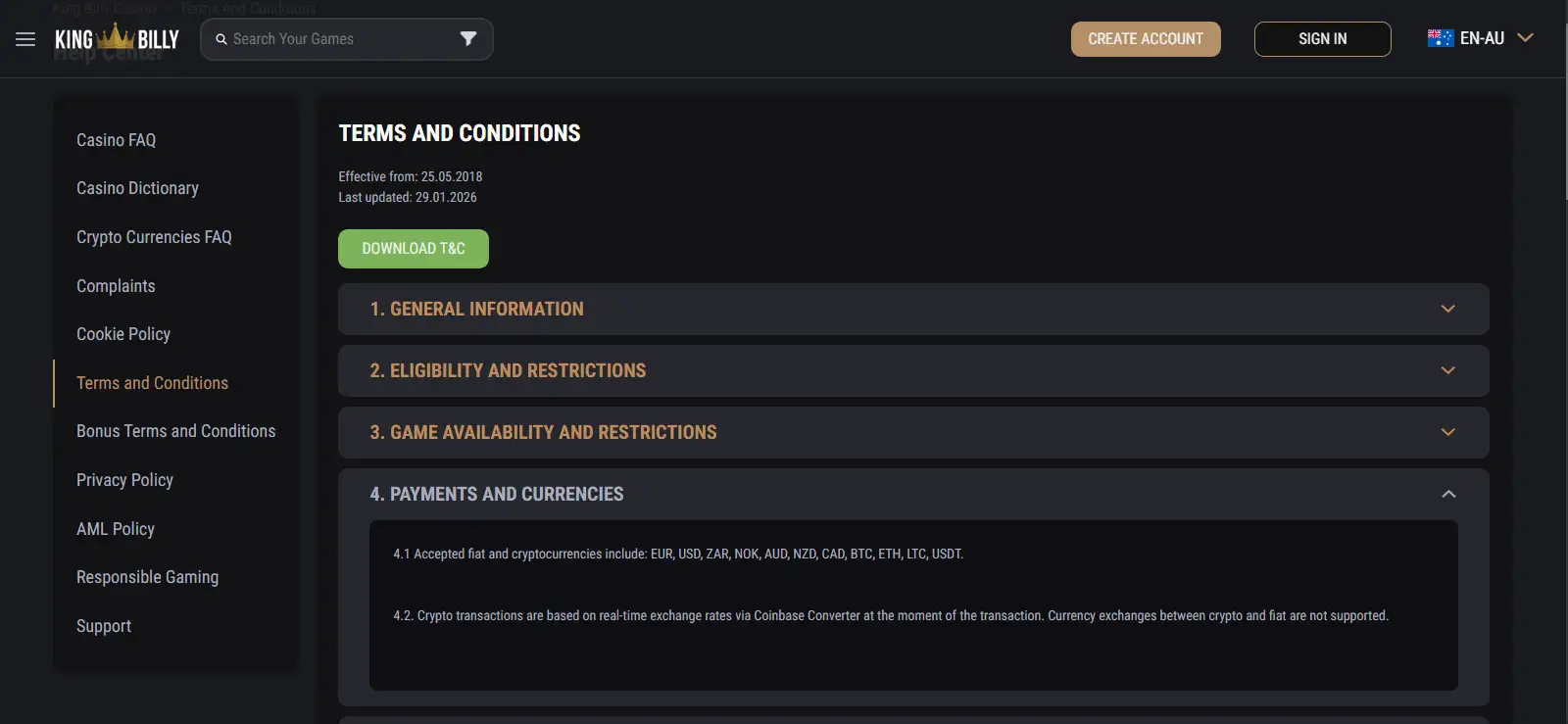
Table of Contents
- Verified at King Billy is not the same as common in Australia
- AUD support and the A$30 minimum deposit
- Cards, e-wallets and bank transfers in the current terms
- Crypto support is part of the wider banking picture
- Deposit methods and withdrawal methods do not have to match one for one
- PayID is not established as a King Billy payment method
- Cashier availability can vary by account, jurisdiction and issuer
- Payment support does not resolve King Billy’s Australian regulatory status
- Mobile access changes the interface, not the payment-method list
- What King Billy’s AUD banking setup means for Australian users
Verified at King Billy is not the same as common in Australia
Australian payment habits provide useful context, but they should not be turned into casino-specific claims. The Reserve Bank of Australia’s 2025 Consumer Payments Survey found that cards accounted for about 73 percent of consumer payments, with debit cards close to half of all payments. Mobile-wallet use also continued to rise, and around half of respondents said they had used PayID in the prior year. Those figures describe Australian consumers generally, not the King Billy cashier.
| Payment item | King Billy terms | Australian context |
|---|---|---|
| AUD | Accepted currency in the current terms. | Local account denomination avoids inventing a currency conversion for general deposits. |
| Visa and Mastercard | Listed as supported deposit card categories. | Cards are the dominant consumer payment method in Australia, but issuer approval is not guaranteed. |
| E-wallets | Listed as an alternative deposit category without a complete account-specific brand list in the public terms. | Do not infer a specific wallet from market popularity. |
| Bank transfer | Listed as a payment category in the current terms. | The selected bank can still reject or restrict a transaction. |
| BTC, ETH, LTC, USDT | Listed among accepted cryptocurrencies. | Crypto use in general Australian payments remains much smaller than card use. |
| PayID | Not listed as a King Billy method in the current public terms. | Widely used in Australia, but that does not establish casino support. |
| Mobile wallets | No specific wallet should be assumed from the public terms alone. | RBA data show rising mobile-wallet use, which is market context only. |
The RBA context is available in its May 2026 consumer payments bulletin. For King Billy, the current cashier and terms determine the listed methods and account-specific availability.
AUD support and the A$30 minimum deposit
King Billy’s current terms list AUD alongside several other fiat currencies and set the minimum AUD deposit at A$30. That is the clearest general banking threshold for an Australian-dollar account. The maximum deposit is not one universal number in the public terms because it varies by payment method and is shown when the method is selected.
That distinction is important for planning a deposit. A$30 tells you the general lower boundary stated for AUD, but it does not guarantee that every card, wallet or bank-transfer option will accept exactly the same range. A payment provider can apply its own transaction limits, and a promotion can set a separate qualifying amount.
If a deposit is connected to a promotion, keep the general A$30 account floor separate from any promotion-specific qualifying amount. For the wider product and regulatory context around the banking facts, use the King Billy Australia review.
Cards, e-wallets and bank transfers in the current terms
The current terms name Visa and Mastercard credit or debit cards and refer more broadly to e-wallets and bank transfers. Those categories are listed, but a particular Australian bank, card product or named wallet may not appear in the cashier for every account.
The terms also require deposits to come from a payment account registered in the player’s own name. That ownership rule is operationally important because a card or wallet that belongs to another person can create a verification problem even if the underlying payment category is otherwise supported.
Issuer-side controls are another layer. King Billy’s terms state that a bank can block or reject credit-card or bank-transfer transactions at its discretion. This is why a payment method can be listed by the casino while still failing for an individual customer. A rejected card is not proof that cards as a category are unsupported, and a successful card transaction is not proof that all Australian issuers will behave the same way.
Crypto support is part of the wider banking picture
King Billy’s current terms list Bitcoin, Ethereum, Litecoin and Tether among accepted cryptocurrencies. Crypto is therefore part of the wider payment-method picture alongside cards, e-wallets and bank transfers.
The terms say crypto transactions use a real-time exchange rate and that the casino does not provide an internal fiat-to-crypto or crypto-to-fiat exchange service. That means a reader should treat cryptocurrency funding as a separate transaction path rather than as an automatic conversion from an AUD account balance.
It is also useful to keep Australian market context in proportion. RBA survey data show that cryptocurrency awareness is high, but actual use as a payment method is low compared with cards. The fact that King Billy supports several cryptocurrencies therefore says something about the casino’s cashier, not about the way Australians usually pay for everyday goods and services.
Deposit methods and withdrawal methods do not have to match one for one
A casino cashier can present more ways to put money in than to take money out. Payment-provider rules, card payout capabilities, bank-transfer requirements and identity checks can all affect the cashout route. King Billy’s terms explicitly reserve the right to use a different withdrawal method when necessary, which is a reminder not to assume that the deposit button predicts the final payout path.
For detailed cashout minimums, limits and processing rules, see King Billy withdrawals. Deposit methods and withdrawal limits answer different banking questions.
Before depositing, it is still worth asking one withdrawal question: if this funding method is available now, what payout route does the account show for later? That simple check is more useful than assuming that a familiar deposit method will automatically be available in reverse.
PayID is not established as a King Billy payment method
PayID is a strong example of the difference between market popularity and brand support. The RBA found that around 50 percent of respondents had used PayID in the prior year, and awareness was even higher. Those figures make PayID highly relevant to Australian payment behaviour.
They do not establish that King Billy accepts PayID. National popularity does not establish casino support. Unless PayID is shown in the current King Billy cashier or an official King Billy payment page, it should remain outside the supported-method list.
The same rule applies to named mobile wallets, prepaid products and local bank-transfer rails. National popularity is a reason to check for a method, not a substitute for checking.
Cashier availability can vary by account, jurisdiction and issuer
King Billy’s public terms describe the broad categories, but the practical cashier is account-specific. Method availability can depend on the selected currency, payment processor, account status, jurisdiction and the rules of the issuing bank. That normal variability should not be turned into a blanket claim that a method is unavailable across Australia.
It also means registration and verification can intersect with banking. A payment account must be in the player’s own name, and identity checks can matter before withdrawals. The King Billy account guide covers the account rules, while the King Billy KYC focuses on verification and the documents the current terms can require.
Payment support does not resolve King Billy’s Australian regulatory status
AUD support, Australian-facing pages and the ability to list common banking categories are product facts. They do not answer the separate question of Australian regulatory status. The operator’s stated overseas licence and Australian regulatory position are separate from payment functionality.
For that separate issue, the King Billy licence and ACMA status explains the Australian regulatory evidence. Keeping payment functionality and licensing status separate avoids two opposite errors: treating an AUD cashier as proof of authorisation, or treating regulatory restrictions as proof that no account can ever display a payment option.
Mobile access changes the interface, not the payment-method list
Australian consumers increasingly use phones for payments, and King Billy can be used through a mobile browser. But a mobile interface does not create extra payment methods. The same rule applies whether the cashier is opened on desktop, iPhone or Android: use the methods actually displayed to the account and do not infer support from the device’s wallet apps.
The King Billy mobile and app covers browser access and the Android APK separately from banking. That keeps the device question from being confused with the payment-rail question.
What King Billy’s AUD banking setup means for Australian users
The current banking baseline is straightforward: AUD is an accepted currency, the general minimum AUD deposit is A$30, the current terms list Visa and Mastercard, e-wallets and bank transfers as deposit categories, and BTC, ETH, LTC and USDT are supported cryptocurrencies. The practical limit is that the cashier and the issuing bank still determine what works for an individual account. Australian payment trends can help explain why readers look for cards, mobile wallets or PayID, but those trends must not be converted into unsupported King Billy features. The most useful banking check is therefore a three-part one: confirm the method in the account, confirm the amount and ownership rules, and confirm the likely withdrawal route before treating the deposit option as fully understood.
Published by the King Billy Casino team.